
Social Media for Teen Entrepreneurs: 6 Skills That Turn Scrolling Into Real Income
The average American teenager spends somewhere between four and seven hours per day on social media.
Here is the question almost nobody is asking about all that time: what is it actually producing?
For most teens the honest answer is nothing. Entertainment. Distraction. A continuous loop of consuming what other people created. Hours that feel social but build no skills, no income, and no compounding advantage of any kind.
For a small and growing number of teens, the ones who understand that social media is not just a place to consume but a place to build, those same hours produce something completely different. Audiences. Income. Business skills. A personal brand that compounds in value for years.
The difference between those two groups is not talent. It is not followers. It is six specific skills.
This post covers all six, starting with the counterintuitive story of an eight-figure social media agency owner who bans her own kids from social media until they turn 18, and exactly what that tells every parent about how these platforms actually work. Then it breaks down the asymmetric advantage that makes social media uniquely powerful for teen entrepreneurs specifically: you have time while your adult competitors have money, and organic content rewards time in ways that paid advertising cannot replicate.

Why Teen Entrepreneurs Fail - And the One Thing That Separates the Ones Who Make It
There is a moment in every teen entrepreneurial journey that is more predictable than any other.
It happens somewhere between week two and week six. The initial excitement has worn off. The novelty has faded. And it is a regular Saturday morning with a hundred easier options available and everything in them is saying there is no good reason to go fill the cooler and head out again.
The teens who go anyway become entrepreneurs. The ones who do not go back to being teens who had a cool idea for a few weeks.
That gap, that single decision made on an unremarkable Saturday morning, is the real answer to why teen entrepreneurs fail. Not lack of talent. Not bad luck. Not wrong timing or wrong product. The refusal to do the boring work when the boring work is all that is available.
This post is about that gap. What causes it, why it is so predictable, and exactly what the teens who close it do differently.
It covers the Glamour Gap, why the version of entrepreneurship that gets shared online creates the exact expectations that cause most teens to quit the moment reality looks different. The real reason teen entrepreneurs fail, they stop one step before the skill catches up to the result, at exactly the moment the skill is about to arrive. The Karate Kid Principle, wax on, wax off, and why the boring repetitive work is always building something the teen cannot see while it is happening. The 100 Doors Math, why 99 rejections is not a bad day but a curriculum, and how every session of boring repetitive work improves the conversion rate that eventually makes the whole thing feel effortless.
It covers the four specific moments when teen entrepreneurs fail most predictably, the session after a great first one, the fourth or fifth session with no breakthrough, the genuinely bad day, and the moment a friend says "are you still doing that water thing?", with the exact response for each one.
And it covers the only formula for how to succeed as a teen entrepreneur that actually works, because it requires committing to the boring work before the hard days arrive, not after.
My son Nate did not sell a single bottle his first time out. He came home with no money, a bruised ego, and every reason to conclude this was not for him.
He went back the next weekend.
Gradually, consistently, compoundingly, the skill developed. The results improved.
That is why consistency in entrepreneurship beats talent every single time. And why the boring work, done without drama and without requiring it to be exciting first, eventually produces something extraordinary.

People Skills for Teen Entrepreneurs: The 5 Pillars That Turn Any Teen Into a Rainmaker
The highest earning people I have ever encountered in business were not always the smartest in the room. They did not always have the best product, the most impressive resume, or the most polished business plan.
But every single one of them, without exception, was exceptional at one thing.
People.
In the business world these people have a name. Rainmakers. And here is what every teen in The Ultimate Lemonade Stand system needs to understand, and what every parent reading this needs to hear clearly: becoming a Rainmaker is not a personality trait you are born with. It is a skill set you deliberately develop. And the teen who starts developing it at 14 while selling water to a thirsty crowd arrives at 22 with an advantage over their peers that no degree, no certification, and no amount of classroom time can replicate.
This post breaks down the five foundational pillars of people expertise that separate the teens who make money from the ones who almost do.

Why 60% of Teens Want to Start a Business - But Only 10% Actually Do (And How to Make Sure Yours Is One of Them)
A board member at the University of North Florida's Center for Entrepreneurship and Innovation said something that has stayed with me ever since.
"Only about 5% of the population are entrepreneurs."
He said it confidently. Matter-of-factly. Like it was simply the nature of things.
I did not push back in the room. But I have been pushing back ever since.
Because here is the data nobody in that room was talking about. Over 60% of teens and young adults in the United States say they want to start a business. Sixty percent. And by the time those teens reach adulthood only 10 to 15 percent are actually running or starting one.
That 45-point gap is not a talent gap. It is not a capability gap. It is not evidence that most people simply do not have what it takes.
It is an exposure gap. A direction gap. An "nobody ever showed me this was actually possible and here is exactly how to start" gap.
This post explains exactly what happens to the other 45 percent, the three ways the entrepreneurial desire gets buried before it ever gets a chance. It breaks down how the college-only narrative quietly filters out entrepreneurial instinct through four specific mechanisms most parents never see coming, including the debt obligation that makes risk almost impossible and the four years of the most valuable entrepreneurial learning window a teen will ever have that get spent preparing for a job market instead of building one.
It covers the three forces converging right now that are about to change the 10-15 percent number permanently, the declining ROI of a college degree, AI lowering the barrier to entry to almost zero, and an entire generation with more entrepreneurial desire than any that came before it.
And it makes the case for why parents are the single most important variable in whether a teen ends up in the 10 percent or the 45 percent, and why the families who give their teens real exposure to entrepreneurship right now, while the compounding still has the most time to work, will be the ones looking back in twenty years understanding why early exposure was the most important thing they ever did.
The desire is already there in your teen. The tools are already available. The opportunity has never been bigger.
The only thing that has ever been missing is someone willing to show them where the thirsty crowd is, and a parent willing to let them go find it.

10 Skills Schools Don't Teach Teens - And Why Every Single One Determines Their Future More Than Grades Do
There are ten skills that will determine your teen's financial future more than any grade they ever receive. Not one of them appears on a report card.
Start with this question: Teen A has a 4.0 GPA, never misses an assignment, and does everything the system asks perfectly. Teen B has average grades, gets distracted easily, asks too many questions, and can't sit still through subjects that don't feel relevant to anything real. Ten years from now, who is more likely to be financially free?
The honest answer is you genuinely cannot tell, because grades measure almost none of the skills that actually determine whether a person builds a life by design or spends their life waiting for one to be handed to them.
This post covers all ten. Selling and communication, the highest-leverage skill that determines every dollar a teen will ever earn, from another human being who had to be convinced. Taking action before feeling ready, the exact opposite of what twelve years of school trains teens to do. How money actually works, the compound interest, Roth IRA, and wealth formula education that wealthy families give their kids at home while everyone else discovers the gap too late. Opportunity recognition, the trained cognitive habit that made Nate look at a crowded park on a hot afternoon and say "Dad, there are a lot of thirsty people here." Resilience and handling rejection, built in the field, never in a classroom. Self-education, AI fluency, time and energy management, the entrepreneurial identity, and delayed gratification, the skill with the most documented impact on long-term outcomes and the one entrepreneurship trains every single weekend.
These ten skills are not a replacement for formal education. They are the completion of it, the half that has always been missing.
The teen who develops them alongside school arrives at whatever comes next with an advantage so significant that the people around them will call it natural talent or good luck.
It is neither of those things. It is the compounding result of developing the right skills at the right age with enough time ahead for everything to grow.
That is what The Ultimate Lemonade Stand is built to produce. Not just a teen who made $100 this weekend. A teen who has the skills, the mindset, the habits, and the financial foundation to build a life that most people only dream about.

Why Getting a Job Might Be the Smartest First Move a Teen Entrepreneur Can Make
Most people think getting a job and building a business are opposites. They are not. Used strategically, at the right moment, for the right reasons, a part-time job is one of the most powerful tools a teen entrepreneur can have, and this post explains exactly why.
The argument is not that teens should abandon the entrepreneurial vehicles. It is that a job does three things none of the other vehicles can do on their own. It funds the first moves before the vehicles can fund themselves, eliminating the one excuse that stops more teens from starting than any other. It keeps the weekly investment habit alive during the inconsistent early weeks when slow selling sessions can make the whole system start to feel theoretical. And most powerfully, it pays a teen to learn the exact industry they are about to compete in before they spend a single dollar of their own money figuring out what the professionals already know.
The teen who spends six months working inside a pressure washing company, a detail shop, or a lawn care crew before launching their own version of that business starts with something most adult entrepreneurs spend years and thousands of dollars trying to acquire, they know what good looks like, what jobs are actually worth, what the hidden costs are, and how professionals handle the situations that sink beginners.
Same job. Completely different teen, depending entirely on whether they show up as an employee or as an entrepreneur in disguise studying everything around them.
The job is not the destination. It is a phase with a purpose and a clear endpoint. When the vehicles are producing consistently, the investment habit is automatic, and the Level 2 business is ready to launch, the job has done its job.
That is not settling for employment instead of entrepreneurship. That is using every available tool to build something real. Which is exactly what entrepreneurs do.
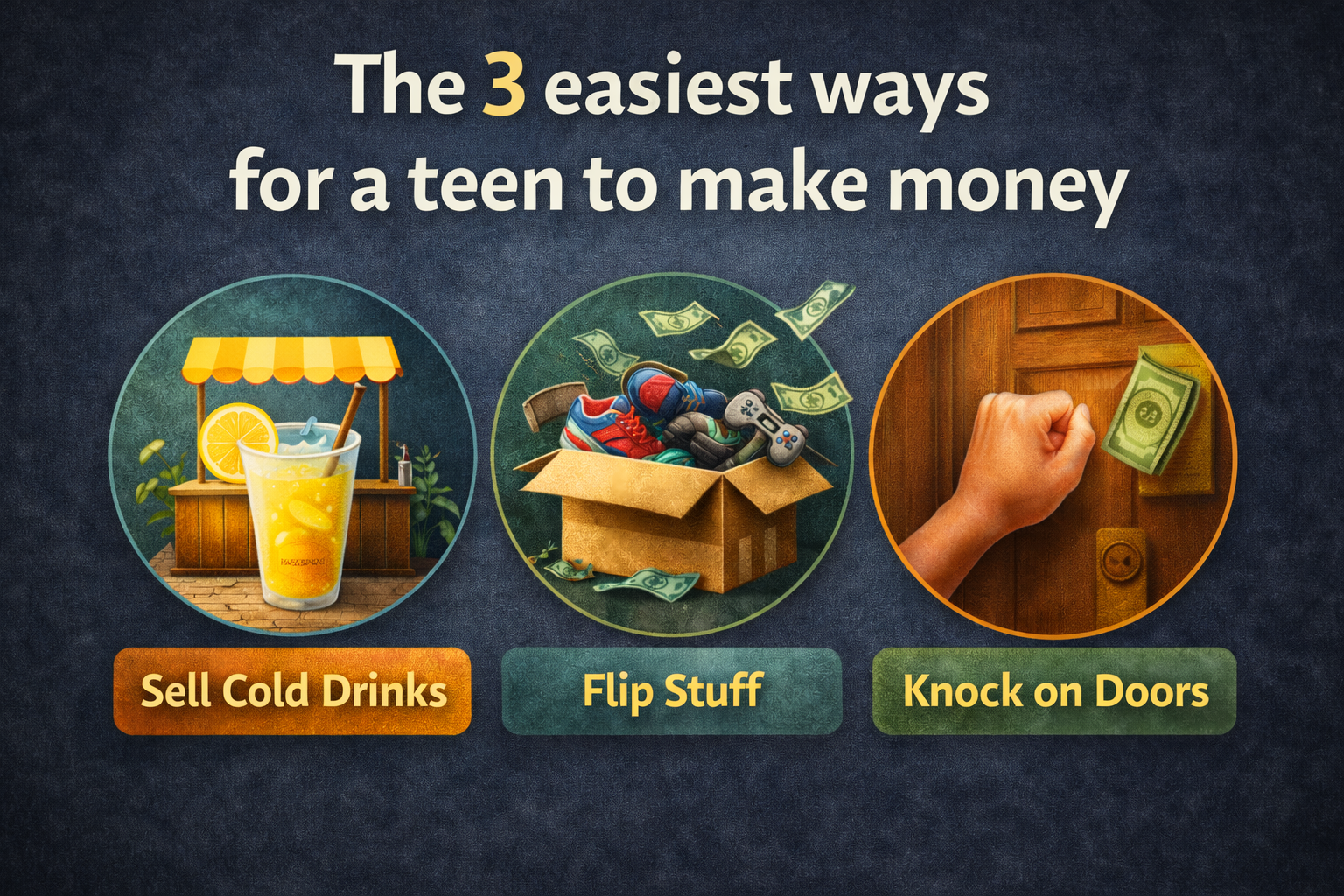
How to Make Money as a Teen: The 3 Easiest Methods That Actually Work (And Why the First $100 Changes Everything)
Most teens wait for the perfect idea, the perfect moment, or the perfect conditions that never quite arrive. This post is not about waiting. It is about this weekend.
And it applies to all three of the money-making vehicles in this post.
The Ultimate Lemonade Stand teaches you that business is not about waiting for customers to find you, it is about going where they already are, hot and thirsty and ready to buy. Flipping items online teaches you that opportunity exists everywhere, every single day, in the gap between what something is worth and what someone paid for it. And door to door, the most uncomfortable of the three, builds something in your identity that no classroom or sports team or minimum wage job can ever produce, the unshakeable confidence that comes from knowing you can walk into any situation, make an offer, and keep going no matter what.
Used together, these three vehicles mean there is no weather, no season, and no excuse that can stop a committed teen from reaching their weekly goal.

Teen Investing for Beginners - How $200 Weekends Turn Into $1 Million
Most teens think investing is something you do later. After college. After the first real job. After you "have money" in the way adults mean when they say that. Here's what that thinking actually costs, and it's a number most adults wish they had seen at your age. This post starts with the biggest financial mistake I ever made, not because I did something wrong, but because I did nothing. Because a mentor sat me down, showed me exactly what to do, and I didn't follow through. And it cost me more than I can stand to calculate. Then it shows you the math that changes everything: what happens when a teen takes $200 a week from ages 14 to 17, invests the $40,000 at 18, and never adds another dollar. The penny doubling experiment that makes compound interest finally CLICK. The Rule of 72. The starting age comparison that shows why $40,000 invested once at 18 produces the same retirement wealth as $480,000 invested diligently starting at 45. Most importantly, the exact steps to make it real this week. Every $200 weekend isn't $200. It's $6,400 at retirement. When you truly understand that math, everything about how you show up changes.
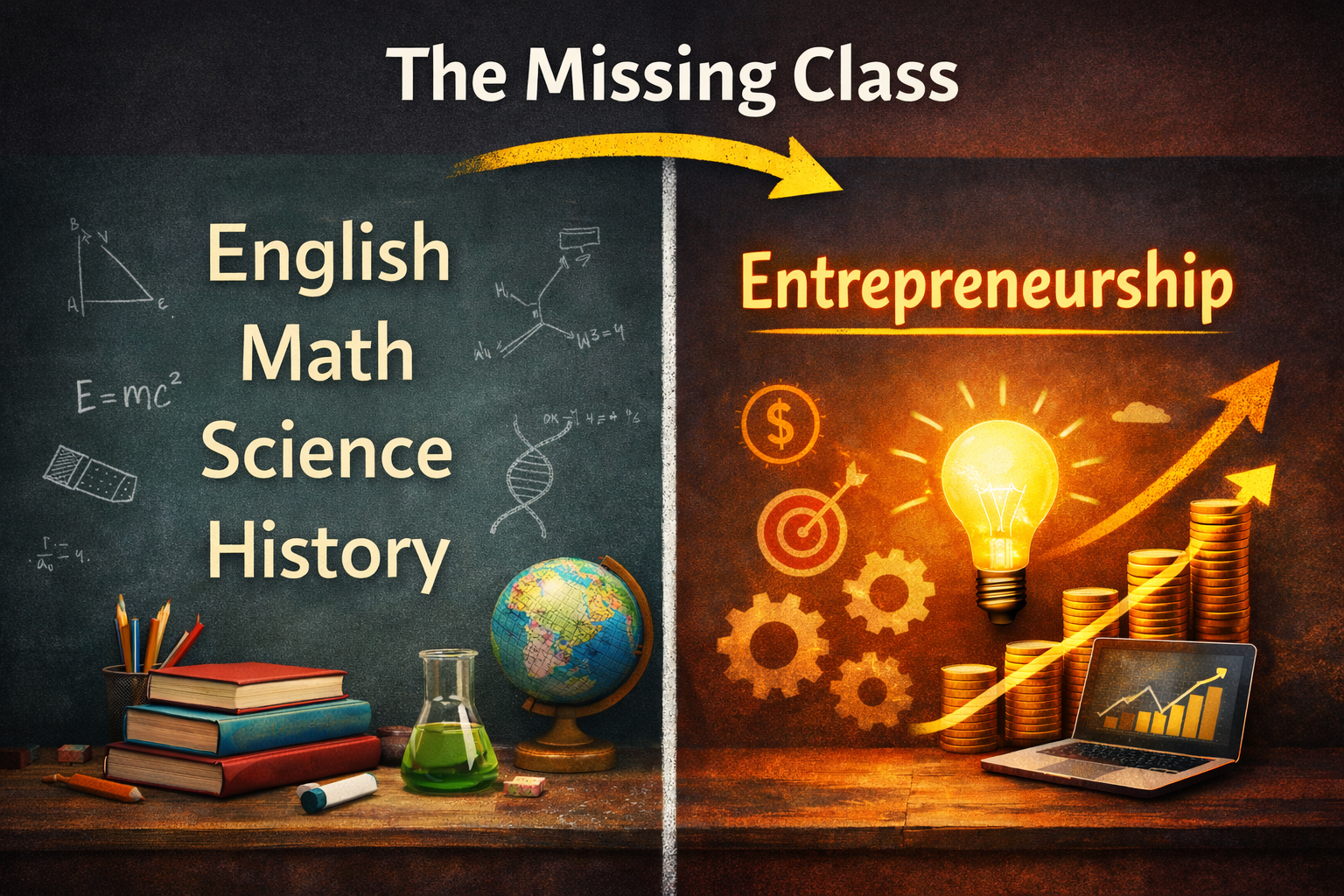
Why Schools Don't Teach Entrepreneurship - And What's at Stake for Your Teen
For decades the formula was simple, good grades, college degree, stable job, secure life. But that formula is breaking faster than most parents want to admit. AI is eliminating the entry level jobs that degree was supposed to unlock. Student loan debt is crushing a generation that followed every rule. And the one skill set that applies to every person in every career in every economic environment, how money works, how value is created, how effort connects to income, is almost completely absent from the education system that is supposed to be preparing young people for life. This post makes the case that entrepreneurship is not an extra. It is the missing class. And the cost of not teaching it is getting higher every single year.

Goal Setting for Teen Entrepreneurs: The Magic Formula That Actually Works
Most people have goals. Almost nobody has a system for actually achieving them. The Magic Formula is a nine-step process, WHAT, HOW, WHEN, BIG, STATEMENT, READ IT OUT LOUD DAILY, IMAGINE IT TRUE, REVIEW AND REVISE DAILY, ACTION, that has been used by the most successful people in history and understood by almost none of the people around you. This post breaks down every single step in real language, with real examples, and connects each one directly to the entrepreneurial journey. Not motivation. Not theory. A repeatable system that works every time you actually work it.

Employee vs. Entrepreneur Mindset: What Nobody Tells Teens Before They Choose a Path
Nobody sat most of us down as teens and explained the real difference between building a career as an employee and building something as an entrepreneur. Not the Instagram version. Not the corporate motivational poster version. The REAL version, with the actual tradeoffs, the honest downsides of both, and the one thing that makes entrepreneurship worth considering even when it is hard. This post lays out both paths completely so teens can make that decision on purpose instead of by default. Because the teens who figure this out early always end up further ahead than the ones who just went along with whatever everyone around them expected.

7 Signs Your Teen Is Wired to Be an Entrepreneur (And What to Do About It)
Most parents of entrepreneurially wired teens spend years trying to manage traits that look like problems, the restlessness, the constant ideas, the risk-taking, the inability to just follow instructions and sit still. This post breaks down seven signs that your teen is not the problem, they are wired for entrepreneurship. And it explains exactly what to do when you see those signs instead of trying to talk them out of it. Because entrepreneurial potential that never gets a real outlet does not disappear. It gets frustrated. And that is a story nobody wants for their kid.

Daily Habits for Teen Entrepreneurs: The Successful 5 That Compound Like Money
Making $100 in a weekend is exciting. But becoming the kind of person who does it over and over again, and turns it into real long-term wealth, that requires something the strategy alone cannot give you. It requires habits. The Successful 5 are five daily practices, reading, writing, affirmations, visualization, and documenting the journey, that compound just like money does. Done consistently they do not just build a business. They build the person capable of running one. This post breaks down each habit, why it works, and what it produces over time for the entrepreneurial teen who takes it seriously.

The ADHD Teen Entrepreneur Advantage: Why These Kids Are Built to Win in Business
The traits that make school miserable for teens with ADHD, the energy, the creativity, the inability to sit still, the willingness to jump in before everything is figured out, are the exact same traits that make great entrepreneurs. In this post we break down why the ADHD brain is not broken, it is just in the wrong environment. And why a system that starts with real action, real selling, and real results, instead of sitting still and memorizing things, might be the environment that finally lets your teen discover what they are actually capable of. The goal is not to fix them. It is to find where they win.

AI Is Replacing Entry-Level Jobs: What Every Teen (and Their Parents) Needs to Know in 2026
AI is not coming someday, it is already here and it is moving faster than a four-year degree can keep up with. In this post we break down why going into massive student loan debt to prepare for a job market that is being transformed in real time is one of the riskiest financial decisions a teen can make in 2026. The teens who win the next decade are not going to be the ones who memorized the most information, they are going to be the ones who know how to create value, sell, build, and adapt. And those skills do not start in a classroom. They start with something as simple as a cooler full of cold water and the willingness to go find a thirsty crowd.

My Teen Doesn't Want to Go to College - A Real-World Guide for Parents Who Don't Know What's Next
Not every teen is built for the classroom, and that is not a failure, it is a fork in the road. In this post we break down four real, legitimate, financially powerful paths for teens who are not heading to college: the military, the trades, sales, and entrepreneurship. Each one can lead to an extraordinary life, but only if a parent shows their teen that these roads exist and helps them take the first real step. The teen who is being labeled unfocused or unmotivated might actually be the most naturally wired entrepreneur in the building. They just need someone to believe that, and show them where to begin.

How to Start a Business as a Teenager: The Step-by-Step Starting Point Nobody Shows You
Most teens who want to start a business don't fail because they aren't capable, they fail because nobody showed them where the actual starting point is. They've been handed a ladder with the first five steps missing and told to climb. In this post we break down why most business advice is completely useless for beginners, why the confidence gap is the real obstacle nobody talks about, and how something as simple as an Ultimate Lemonade Stand gives teens the foundation that makes everything else possible. The problem was never the teen. It was always the starting point.

Should Teens Have a Side Hustle? Why the Answer Is Yes - And Why Parents Should Encourage It
Some teens are just wired differently. They're not worried about money too early, they're actually ahead of the game. In this post we break down why entrepreneurial teens shouldn't be discouraged, why shutting down their hustle does more harm than good, and why the REAL risk isn't a teen who works too hard, it's a teen who never learns how money, responsibility, and independence actually work. If your teen is already showing signs of that entrepreneurial fire, this is the post you need to read before you accidentally put it out.

How Teens Can Make Money in 2026: From Lemonade Stands to Online Business
The old way of making money as a teen had a hard ceiling, local, labor-heavy, and limited. The internet changed everything. In this post we break down how today's teens can go from selling lemonade on the corner to building real income online through dropshipping, affiliate marketing, content creation, information marketing, and freelance services. The tools are new but the fundamentals haven't changed — mindset, work ethic, and the entrepreneurial fire that starts with that very first sale still matter more than anything. The lemonade stand was never the destination. It was always just the beginning.

How to Teach Your Teen Entrepreneurship - Starting With a Lemonade Stand This Weekend
Teaching teens entrepreneurship doesn't start with textbooks or business plans, it starts with action. This post walks parents through exactly how to turn a simple lemonade stand into a complete entrepreneurial training ground, step by step, covering everything from finding customers and learning to sell, to investing the first dollar earned and letting failure do its job.