How to Make Money as a Teen: The 3 Easiest Methods That Actually Work (And Why the First $100 Changes Everything)
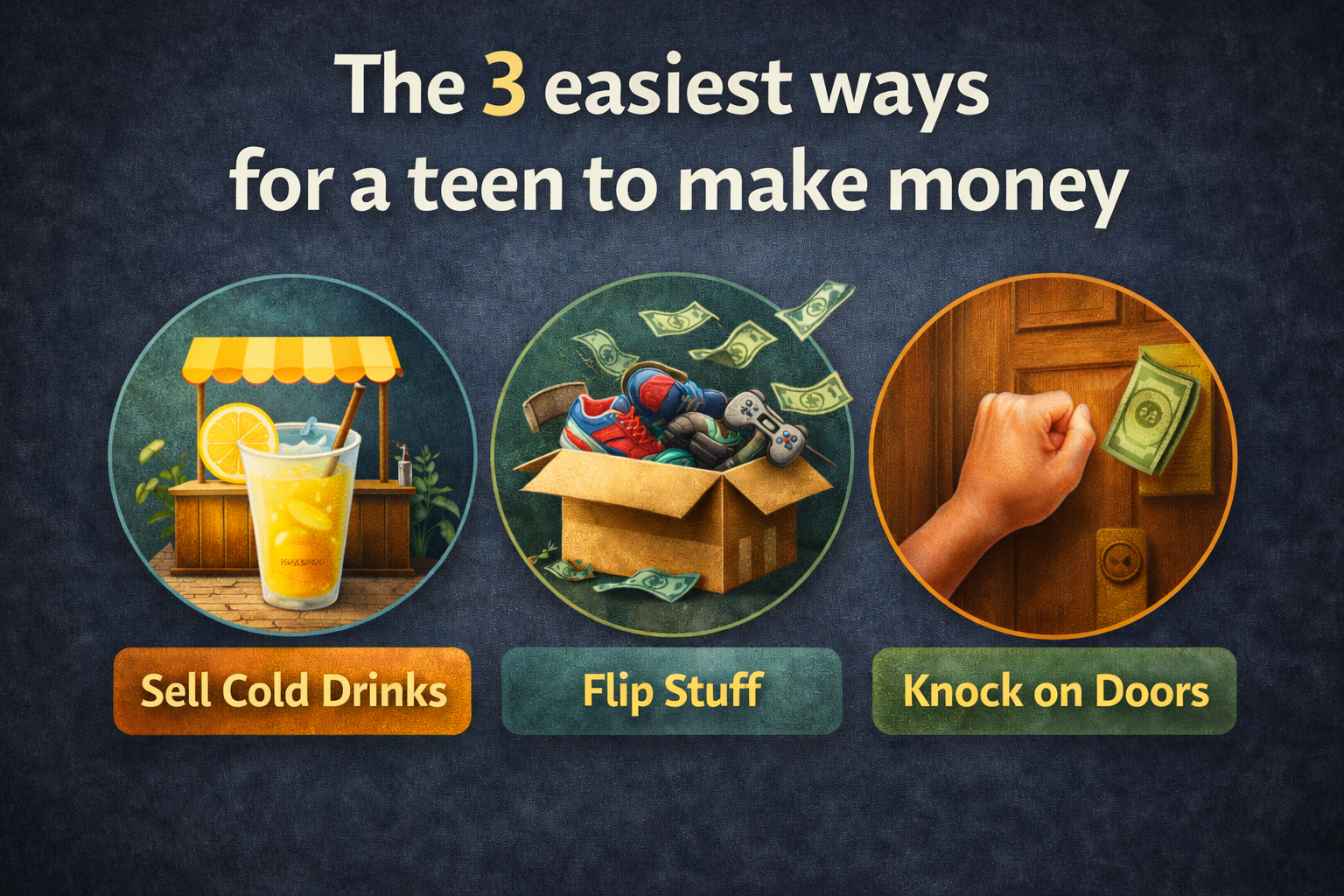
Behold, the 3 easiest ways for a teen to make money!
What if you could make your first $100 this weekend?
Not someday. Not after you figure out what you want to do with your life. Not after college or a degree or a business plan or a perfectly timed moment when everything feels ready.
This weekend. Saturday afternoon. Real money. Yours.
I know that sounds like the kind of thing people say on the internet to sell you something. So before I say anything else let me tell you what this actually is.
My son Nate figured out how to make money as a teen the way most people never do, not by finding the perfect idea, but by going where the thirsty crowd already was.
He has made three times what his friends earn per hour at their regular jobs, selling cold water at a park, at festivals, and sporting events. Not because he is some exceptional sales prodigy. Not because he had a rich dad who set everything up for him. Because someone showed him where the thirsty crowd was and he went and found it.
That is the whole secret. And I am going to give it to you completely in this post.
But first I need to tell you something more important than any of the three methods I am about to explain.
Before the Money Comes the Decision
Here is the thing most teens do when they want to make money. They think about it. They research it. They watch videos about it. They talk to their friends about it. And then they wait for the perfect idea or the perfect moment or the perfect conditions that never quite arrive.
The teens who actually make money, the ones who build confidence and skills and real income before most of their peers have even started, do not do that.
They make a decision before they go out the first time. Not a decision about which method to use or which location to pick or how to handle every possible situation. A simpler and more important decision than any of those.
They decide in advance that they are going to start. That they are going to feel awkward and do it anyway. That they are going to get rejections and keep going. That they are going to have slow days and show up the next weekend. That the boring consistent work IS the strategy and not a sign that something is wrong.
That decision, made before the first sale, before the first rejection, before the first session where everything goes differently than planned, is what separates the teens who build something real from the ones who tried once and stopped.
Make that decision before you read any further. Write it down if you have to.
"I am going to start this weekend. I am going to keep going. I am becoming an entrepreneur."
Now let me show you exactly what to do.
The 3 Proven Ways for Teens to Make Money: Your Level 1 Vehicles
These three methods have one thing in common, any teen can execute any one of them this coming weekend with almost no startup cost, no experience, and no complicated setup. They are designed to do one thing above everything else.
Get you your first win.
Because here is what I know from watching Nate and from studying every successful entrepreneur I have ever admired, the first win changes your identity. The moment you make your first real sale, count your first real profit, and feel the weight of money that YOUR effort produced, something shifts permanently. You stop wondering if you CAN make money and start figuring out how to make MORE. That shift is worth more than any single dollar amount.
These three vehicles are specifically chosen to produce that shift as fast as possible.
Vehicle 1: The Ultimate Lemonade Stand - The Fastest Way for a Teen to Make Money Starting Saturday
Here is the simplest possible explanation of the Ultimate Lemonade Stand.
Buy cold water in bulk for about fifteen cents per bottle. Sell it for two or three dollars per bottle. Do it where a lot of thirsty people already are. Repeat until you have made $100 to $200 in profit.
That is the whole business model. And I promise you it works, because my son has proved it over and over again and because the math is completely undeniable.
But here is the one insight that separates the teen who makes $7 on a slow Saturday from the teen who makes $200 before lunch. And it is not the product. It is not the sign. It is not the price.
It is the location.
The traditional lemonade stand fails not because lemonade is a bad product but because it sits at the end of a quiet driveway hoping the right person happens to walk by. That is hope marketing. It produces hope results.
The Ultimate Lemonade Stand flips that completely. Instead of waiting for customers to find you, you go find THEM. You find a thirsty crowd and you show up in the middle of it with exactly what they need at exactly the moment they need it.
A park with volleyball courts on a hot Saturday. A youth soccer tournament with parents watching from the sidelines. A festival or car show or outdoor market with hundreds of people moving around in the heat. A busy parking lot outside a sporting event.
Every one of those locations is a room full of people who are already hot, already active, and already thinking about how much they want something cold to drink. You are not selling water. You are solving a problem that already exists. That is what business actually is, finding a problem that already exists and getting paid to solve it.
Here is the math so you can see exactly what is possible:
Seventy bottles at $3 each = $210 in revenue. Subtract approximately $10 in costs for water and ice. Net profit = $200 in a single afternoon.
Is that guaranteed on day one? No. Nate's first day produced zero sales. Could not give them away. But what he learned that day about location and approach and reading a crowd was worth more than any $200 session he has had since. He came back the next weekend smarter. And the weekend after that he made more than three times what his friends earn per hour at their jobs. That is cool and all, but what’s more important is understanding why every dollar Nate earns is worth far more than it looks at retirement!
This is how to make money as a teen in a single afternoon, not someday, not with a complicated setup, but this Saturday with a cooler and a crowd.
What your teen actually learns from the Ultimate Lemonade Stand:
Every session is a masterclass in the skills that compound into extraordinary results over time. How to approach a stranger confidently. How to make an offer and ask for the business. How to handle a no with grace and immediately move to the next person. How location and crowd type and timing all affect sales. How to track revenue and costs and calculate actual profit, not just what you collected. How to adjust and improve based on real data rather than theory.
And the most important skill of all, the one that every successful entrepreneur, executive, salesperson, and leader on the planet has developed, how to take action when you are not sure how it is going to go and keep going when it does not go perfectly.
Before you go, do these things:
Research your location. Google your city's vendor permit requirements before you set up anywhere. Some locations require permits and operating without one can get you shut down and cost you the whole day. Call the park, event organizer, or property owner and confirm you have permission. Ten minutes of preparation protects everything you are about to build.
Some people have an “ask for forgiveness” approach. At one festival, without permission, Nate was asked to leave by someone running the event. There are kids all over the country on any given weekend getting shut down by the police for having a lemonade stand, and there are many more that didn’t!
Buy water in bulk from Costco, Sam's Club, BJ's Wholesale, or Restaurant Depot. A case of 24 bottles typically costs $3-$5 at a wholesale club, approximately fifteen cents per bottle. Never buy from a regular grocery store. The margin disappears and the whole business model breaks.
Get a cooler with wheels. Have cash for making change. Set up Venmo and Cash App on your phone so you never lose a sale because someone does not have cash. And make sure a parent or guardian is involved, every session, no exceptions. Safety first always.
I hope this doesn’t make it seem more complicated than it really is. Part of being an entrepreneur is doing things the right way. Simplicity is key! We are starting at the very BEGINNING with the step-by-step starting point that most teen entrepreneurship guides skip.
The verbal approach that works:
Walk toward people confidently. Make eye contact. Smile before you say anything. Then, "Ice cold water, three dollars!" That is the whole pitch. Clean, direct, confident. If they say no you say "No problem, enjoy the event!" with genuine warmth and you move immediately to the next person. Never linger. Never push. The energy of someone who is busy and confident and genuinely enjoying what they are doing sells more water than any clever line ever will.
Vehicle 2: Flipping Items Online - The Rain or Shine Teen Side Hustle That Works 365 Days a Year
If the Ultimate Lemonade Stand teaches you the power of finding a thirsty crowd, flipping teaches you the power of recognizing opportunity where other people see clutter.
The concept is beautifully simple. Find something that people want to buy. Acquire it for less than they will pay for it. Sell it to them. Keep the difference.
That gap, between what you paid and what someone else will pay, is profit. And it exists absolutely everywhere, every single day, because the world is full of people who are selling things for less than those things are worth and other people who would gladly pay more for them if they could just find them.
Your job as a flipper is to be the bridge between those two groups of people. And the profit in between belongs entirely to you.
For teens who want to make money year-round regardless of weather or location, flipping is the most versatile vehicle available.
Here is what makes flipping the most versatile Level 1 vehicle:
It works when it is raining and the park is empty. It works in January when no outdoor events are running. It works at 11pm from your bedroom. It works regardless of where you live, urban, suburban, rural, anywhere with an internet connection. Weather proof. Season proof. Location proof. Age proof really. Lots of retirees turn into flippers! The single most consistent money-making vehicle available at Level 1 because the opportunities literally never stop.
Where to find inventory:
Your own bedroom is the starting point and it costs absolutely nothing. Right now you almost certainly own items you no longer use that someone else would pay real money for. Old electronics, video games, sports equipment, clothing, shoes, collectibles, books. Before you spend a single dollar on external inventory look at what you already have and get comfortable with the process.
From there the world opens up. Garage sales and estate sales where sellers are motivated to move items quickly and will often accept offers well below their listed prices. Thrift stores where pricing is often done by volunteers who do not always know what items are actually worth online. Clearance sections at major retailers where items are marked down to clear space and can often be resold at or above original retail. Facebook Marketplace and Craigslist where people post things they want gone fast, sometimes for free.
The neighbor I know who turned flipping into a genuine income stream specialized in one niche, women's shoes. That is it. She learned that market inside out, knew exactly what brands and styles sold fastest at what prices, and built a consistent operation around one category. There is a teen who started flipping Nike sneakers as a hobby, traveling to wholesale locations, buying at wholesale prices, selling at retail online. He eventually made over a million dollars doing it. He started exactly where you are starting, with one item and one sale.
Makes you wonder exactly how teens can make money in 2026 at every level from first flip to full online business? There are teens out there doing it right now!
The research step that separates smart flippers from expensive guessers:
Before you buy anything to resell do this one thing. Go to eBay and search for the exact item. Then filter to SOLD listings, not active listings, sold ones. This shows you what people have actually paid for this item recently. That number is your ceiling. Your purchase price needs to leave enough room for a meaningful profit after platform fees and any shipping costs.
This is the single most important habit in all of flipping. Never buy to resell based on a feeling or a guess. Buy based on confirmed demand and confirmed price. The teens who skip this step lose money. The ones who do it consistently make it.
Creating listings that actually sell:
This is where flipping quietly teaches one of the most valuable business skills available — copywriting. Writing words that sell. Your listing has three elements that determine whether someone clicks Buy Now or keeps scrolling.
The photos are the first impression and they are everything. Clean the item thoroughly before photographing it. Use natural light near a window, not a dark room, not a flash. Shoot against a clean neutral background. Take at least five angles, front, back, sides, any flaws, the brand label or model number. Honest photos that show exactly what the buyer is getting build trust and prevent disputes.
The title is your headline and it needs to contain the information a buyer is specifically searching for. Brand name, model, size, color, condition. Not "great shoes barely worn", "Nike Air Max 270 Size 10 Black White Excellent Condition." Specific beats generic every single time.
The description is where you sell it. What condition is it really in? What does it include? Are there any flaws to disclose? Be completely honest, buyers who feel misled leave bad reviews and can return items at your expense. Buyers who feel you were transparent and thorough trust you immediately.
Safety - non-negotiable for every in-person transaction:
Always meet in a public place. Busy parking lots, coffee shops, police station community parking lots, many police departments actually designate areas specifically for safe exchange meetups. Always bring a parent or trusted adult. Confirm payment before the item changes hands. Never go to a stranger's home to complete a sale.
Vehicle 3: Selling Door to Door - The Most Uncomfortable Method That Produces the Most Extraordinary Results
I want to be completely honest with you about this one before we go any further.
Door to door is uncomfortable. The first time you stand on a stranger's porch waiting for the door to open your heart is going to pound. Your palms might sweat. Everything in you is going to want to walk back to the car before you even ring the bell.
Ring it anyway. Why this discomfort is exactly how entrepreneurship builds real confidence in teenagers.
Because here is the thing about that discomfort that nobody tells you, it is the whole point. The teen who goes through that discomfort consistently, who knocks the door after the rejection and the next door after that, is building something in their nervous system and their identity that no classroom, no sports team, no minimum wage job, and no amount of reading about entrepreneurship can ever produce.
They are building the unshakeable confidence that comes from knowing they can walk into any situation, make an offer, handle whatever response they get, and keep going. That confidence shows up in every sale they make for the rest of their life. It shows up in every job interview. Every pitch. Every difficult conversation. Every moment that requires them to advocate for themselves or for something they believe in.
Door to door is not just a money-making vehicle. It is the most accelerated confidence and communication training program available to a human being. And it costs nothing but the willingness to knock.
Two phases - start where you are:
Phase 1 is for younger teens or anyone who wants to start with something tangible and simple. You sell a physical product door to door. Handmade items, crafts, baked goods, seasonal decorations, dog treats, soap, cookies. A teen selling homemade chocolate chip cookies in a friendly neighborhood on a Saturday afternoon is going to find far more supporters than rejectors. People love encouraging young entrepreneurs. They will buy something they do not need just because they want to support a kid who is out there hustling. Use that advantage.
Phase 2 is where this transitions directly into “Level 2” of the entire ULS system. You sell a service, lawn care, car washing, pressure washing, window cleaning, poop scooping, leaf raking, any outdoor service that homeowners regularly need done. This phase is specifically designed to test which service you want to build into a real recurring business. Do not commit to building a lawn care company before you have knocked on 50 doors offering lawn care and confirmed that customers exist in your area and that you actually enjoy doing it. Phase 2 door to door is your market research and your pilot program simultaneously. How to teach your teen entrepreneurship through every level of the system.
The legal and safety steps that protect everything:
Check your local solicitation permit requirements before you knock a single door. Google "[your city] door to door solicitation permit." Rules vary dramatically by municipality. Some areas require nothing. Others require a permit you can obtain easily and inexpensively. Some have restricted hours. Know the rules before you go out.
Respect every No Soliciting sign without exception. Skip those houses completely without hesitation.
Always bring a parent or trusted adult. Always knock during daytime hours. Always stay in familiar neighborhoods. Always let someone know your exact route before you leave. Never enter a stranger's home for any reason regardless of what they offer. Your safety is non-negotiable and no sale is ever worth compromising it.
The exact script that works:
Stand back from the door before it opens, give people space and you look less threatening. Smile before the door opens because your expression when they first see you matters more than your first word. Then:
"Hi! My name is [NAME] and I am [offering/selling] [PRODUCT or SERVICE] in the neighborhood today. I am [offering a service / selling] for [PRICE], would that be something you might be interested in?"
That is the whole script. Confident but not aggressive. Friendly but not desperate. Direct enough that they know immediately what you are there for.
If they say YES, have your phone ready to book them immediately. Do not leave without a confirmed appointment or a completed transaction.
If they say MAYBE or want more information, get their contact information and follow up within 24 hours. A maybe that gets followed up becomes a yes far more often than people expect.
If they say NO, "No problem at all, I really appreciate you answering the door. Have a great day!" Then hand them a simple business card or flyer with your contact information and move immediately to the next door. Always end positively. The neighborhood is watching even when you think it is not.
The mindset that makes this work:
Business is a numbers game. If your conversion rate is 5 out of every 100 doors, and that is a perfectly realistic starting point, then every no you receive is mathematically moving you closer to your next yes. The nos are not working against you. They are working FOR you. Three nos in a row means you are three steps closer to your next sale.
Track your numbers from day one. How many doors did you knock? How many answered? How many said yes? What was your conversion rate? That data tells you something specific after every session, what changed, what improved, what to try differently next time. The teen who tracks their door to door numbers is building real business intelligence. The one who does not is just knocking and hoping.
Why the Smartest Teens Who Make Real Money Use All Three Together
Each vehicle has a specific superpower and a specific limitation.
The Ultimate Lemonade Stand generates fast cash and real-time selling experience but depends on weather, events, and location availability.
Flipping generates consistent income rain or shine and 365 days per year but requires research, patience, and reinvestment discipline.
Door to door builds the deepest communication and sales skills of any Level 1 activity but depends on neighborhood safety and local permit rules.
Together they form a system that has no excuse for not working on any given week.
Cold and rainy this weekend with no outdoor events? Flip. Perfect weather and a big tournament happening across town? Ultimate Lemonade Stand. Great weather and a great neighborhood nearby with a service you want to test? Door to door.
The teen who commits to all three as a rotation always has a vehicle available. Always has a path to the weekly $200 investment goal. Always has a reason to go out and build the skills that compound into something extraordinary. Why teens should have a side hustle and why parents who encourage it give them an unfair advantage.
The Only Thing Standing Between Your Teen and Their First $100 This Weekend
It is not talent. They have enough. It is not experience. They do not need it yet. It is not money. These vehicles require almost none. It is not the perfect idea. These three are proven and waiting.
It is the decision to start. What that first $200 actually becomes when a teen invests it instead of spending it.
Make it today. Go out Saturday. Make the first sale. Count the first profit. Transfer the first investment.
And then do it again next weekend.
Because the teens who make it to $10,000 and beyond are not the ones who had the best idea or the most natural talent or the most support. They are the ones who started when they did not feel completely ready and kept going when it was uncomfortable and did the boring work consistently when the excitement wore off.
That teen can be yours. That teen can be you.
The cooler is not going to fill itself.
Go fill it.
Knowing how to make money as a teen is not the hard part. The hard part is making the decision to start. You now have both.
